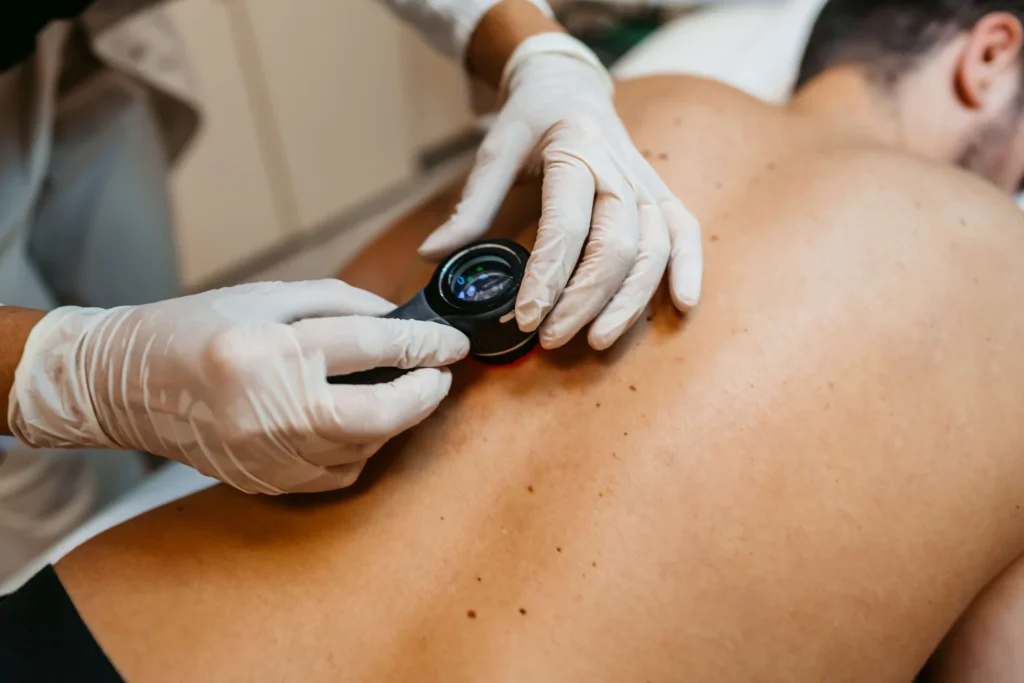
Learn why regular mole examinations are important, how the ABCDE rule is used for self-examination, and how to prevent melanoma. Advice from Dr Irena Komljenović.
Regular dermatological check-ups of moles are essential for maintaining skin health and preventing the development of skin cancer, including melanoma, the most dangerous form of skin cancer. Moles, or naevi, are benign skin formations that occur due to the accumulation of pigment, and most of them are completely harmless. However, certain moles may change shape, size or colour over time, which can be a sign of malignancy. That is why it is important to monitor skin changes and visit a dermatologist regularly.
A mole examination includes several key elements. The dermatologist uses a dermatoscope, a specialised device that allows a detailed view of the mole’s structure, making it easier to identify possible signs of malignant changes. In addition, the dermatologist carefully examines all moles on the body, including those in hard-to-reach areas such as the scalp or between the fingers, which are often overlooked.
Regular check-ups are recommended for people with a higher number of moles, especially if they have a family history of skin cancer. People with lighter skin, those who tan easily or have had sunburns, should also be particularly careful. Dermatological examinations may be recommended annually, or more frequently depending on the patient’s risk level and specific circumstances.
One important criterion for identifying suspicious moles is the so-called “ABCDE” rule. This means paying attention to asymmetry of the mole, irregular borders, changes in colour, increase in size, and bleeding or itching. If any of these changes are noticed, it is necessary to visit a dermatologist immediately.
ABCDE rule:
A for asymmetry: One half of the mole does not match the other half.
B for border: The edges of the mole are irregular, uneven or unclear.
C for colour: The mole has multiple colours or uneven pigmentation.
D for diameter: The mole is larger than 6 mm.
E for evolution: The mole changes in size, shape or colour over time.
If you notice any of these signs, you should schedule a dermatology examination for further evaluation.
Skin self-examination should be performed regularly, approximately once a month. Start by examining the entire body, including the back, arms, legs, palms, soles, between the fingers and the scalp, using a mirror for hard-to-see areas. Use a second mirror to check the back and neck.
Regular mole check-ups are not only about identifying potential problems, but also about educating patients on proper sun protection, as well as skin self-examination that should be performed between dermatological visits.
Proper sun protection includes clothing coverage and broad-spectrum sunscreen with SPF 30+ (UVA and UVB), applied 30 minutes before going outside, reapplied every two hours and after swimming in the sea. Avoid sun exposure between 09:00 and 17:00. Do not use tanning beds!!! Monitor the UV index and plan your activities accordingly.
In conclusion, regular dermatological mole check-ups play a key role in preventing skin cancer and allow timely response in case of any changes.
Prevention is the best way to maintain skin health and prevent the development of serious conditions.
Your skin remembers every moment in the sun. Do not delay prevention – book your dermatoscopy appointment with Dr Irena Komljenović today.